|
Could a Tsunami Hit the Pacific Northwest?
It has and can again. See this animation
from a government website showing how a tsunami like the one that
hit in 1700 could reach the coast in less than an hour with a surge
exceeding 20 feet high in confined harbors. How prepared are residents
and who knows if they live in a tsunami flood zone?
News Commentary - January 3, 2005
TSUNAMI WARNING SYSTEMS "WON'T BE SUFFICENT"
TO PREVENT MASSIVE LOSS
The type of tsunami warning systems now being discussed
by governments in news reports will not be sufficient to prevent
massive economic loss, because new construction methods are also
essential, according to a natural disaster prevention expert whose
book describes defenses against catastrophes such as the Asian tsunami.
"It would be a serious error to think that by
dropping a few buoys into the ocean and hooking them up to satellites
we can prevent the kind of massive economic dislocation that occurred
with the Asian tsunami," said bestselling natural disaster
author Douglas Mulhall. "This will require a whole new way
of approaching coastal development in tsunami risk zones, and a
lot of retrofitting for what is already in place."
Mulhall has already urged the tourism industry to
act, as shown in the attached earlier news release, but today expressed
"alarm" at the lack of attention to construction standards,
with only a narrow focus by authorities on warning systems.
"Warning is a good first step but on its own
it completely insufficent."
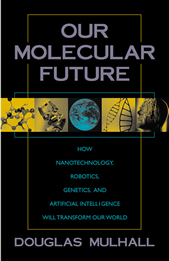
Mulhall's book Our Molecular Future examines such
new designing methods. For more information email
or contact Jill Maxick, Prometheus Books 1-800-421-0351.
-30-
News Release - January 1, 2005
TOURISM INDUSTRY MUST ADOPT TSUNAMI TECHNOLOGY
TO RESTORE CONFIDENCE
The international tourism industry must forge an alliance with
scientists "without hesitation," to help Asian economies
recover, and prevent more mass death from tsunamis around the world,
according to a natural disaster prevention expert whose book describes
defenses against catastrophes such as the Indian Ocean tsunami.
"The tourism industry must recognize what scientists have
said for years," said bestselling author Douglas Mulhall. "Resorts
in the Pacific, Atlantic, and Mediterranean are seriously at risk
from tsunami. The technology to protect tourists from these is available
now, and the tourism industry can't wait for governments to introduce
them."
Mulhall wrote Our Molecular Future (Prometheus Books 2002)
that describes how new technologies can protect us from natural
disasters.The book is on the New Scientist 'must-read' list. He
managed a scientific institute in Hamburg, Germany specializing
in flood prevention and water purification.
He said that measures can be taken right now to protect millions
of tourists from tsunami, and that this can be done inexpensively
through an alliance between resorts, the telecommunications industry,
and tsunami scientists.
"The first thing: establish emergency communications lines
with the tsunami warning centers."
"Then put inexpensive tsunami detection devices off the coast
near major seaside resorts."
"Finally they can support research and development of nanotechnology-based
tsunami sensors that could slash costs for tsunami detection."
"The tourism industry can lead this recovery instead of running
behind it," Mulhall urged, "This is a pittance in cost
compared to what has just been lost by the industry and the world."
Mulhall added that resorts in the affected Indian Ocean region
must be "completely redesigned" when rebuilt, to take
account of what happened, and existing resorts in other regions
must be modified.
"So often things are just rebuilt the way they were, and we
can't afford to do that in this case," he urged.
"Tourism is the economic driver of many of these regions,
and to avoid these areas being thrown into a depression, the industry
must act quickly."
"Tourism will be the backbone of recovery, but only if confidence
in safety is restored," Mulhall observed.
For more information email
or contact Jill Maxick, Prometheus Books 1-800-421-0351.
-30-
*************************************
GLOBALIZED TSUNAMI WARNING NETWORK MUST INCLUDE
ATLANTIC AND MEDITERRANEAN
The Atlantic may be next. One of the great natural disasters of
our time has occurred from a tsunami that swept across the Indian
Ocean. But it is a mistake to blame local governments alone for
failing to build early warning systems, or to think this couldn't
happen on the Atlantic shoreline. Such a catastrophe was forecasted
in the book Our Molecular Future. So was an inexpensive way
of saving lives. Western governments, industries, and aid agencies
could have paid "an ounce of prevention" for a cheap globalized
tsunami warning network.
NEWS RELEASE: ATLANTIC COAST ALSO AT RISK
December 28, 2004 - The Atlantic shorelines of American and Europe
are just as much at risk from a catastrophic tsunami as the Indian
Ocean was, says the author of a technology book about high-tech
defenses against giant earthquakes and tsunamis.
Our Molecular Future (Prometheus Books 2002) by Douglas
Mulhall describes how advanced technologies could prevent wholesale
loss of life such as that seen in the Christmas catastrophe.
The book forecasted that it would take such a globalized catastrophe
to shake governments and industries into using inexpensive, cutting
edge technology to prevent so much death.
Thousands of fatalities from an Indonesian tsunami were "largely
avoidable, and a serious warning for Atlantic Ocean nations"
says Mulhall. "Around 1700 a tsunami wiped out the southern
coast of Portugal, and we're about due for another such event. European
countries are not adequately prepared for this, and America is not
ready for other possilbe tsunamis in the Atlantic," he emphasized.
"The question is, will the Indonesian tsunami wake up everybody?
We'll see if this one is big enough to force globalized solutions,"
Mulhall said. "We have globalized tourism, oil, and other industries
- it's time for a globalized tsunami detection network. It's billions
of dollars cheaper than the loss of life we've seen here" .
"The world science community has been calling for a globalized
tsunami detection network for years and no one heard them, especially
the tourism industry whose millions of customers are at risk, and
western governments whose nationals are at risk when they visit
seaside communities, or aid agencies who have to clean up the mess"
Mulhall said.
"What's maddening about this disaster" he said, "is
that we don't have to wait for new technologies - everything is
available right now."
"The idea that tsunami preparedness is expensive is a ludicrous
myth," he emphasized. "Look at how many millions of dollars
the aid agencies have already come up with in a day. Just a fraction
of that would have prevented such vast death."
Mulhall added that western nations as much as developing countries
"must be held accountable" for the massive yet avoidable
loss of life because they have billions of dollars invested and
millions of citizens visiting in the region.
He chastized aid agencies for "failing to step up to the plate
with an ounce of prevention to prevent a pound of cure." "This
was waiting to happen" said Mulhall. "The risks have been
there all along. They knew about them and had been told about them.
A few million dollars would have done it."
Mulhall harshly criticized "lame excuses already being hatched"
by western governments and other agencies. "It is nonsense
to say that this was a surprise. Every big tsunami is a 'surprise',
but that doesn't mean we can't plan to survive them. Especially
in Indonesia they are regular phenomena along with earthquakes.
International agencies have known that for a while."
Mulhall pointed out that thousands died in Indonesia in 1992 due
to tsunami and quake.
For more information email
-30-
Another risk from earthquakes - vast gas releases:
Vast
methane hydrate deposits have been discovered in an earthquake
zone off North America's west coast. Violent release of such
natural gases may drive climate changes and upend our theories of
how the climate works.
|